More than anything else, I am happy to report that this is the second book that I have finished in four and a half days. I don't want to jinx myself or anything, but it may very well be that after a l-o-o-o-n-g bout of inability to read brought about by chemo brain... maybe the fog is lifting. I plowed through FIND ME, and I read THE SHIPPING NEWS in just a day and a half. This is exciting. This feels like... well, the old me.
I first read THE SHIPPING NEWS when it won the Pulitzer back in 1993. The nine-year-later re-read felt fresh and new. I remembered so little. I remembered the sad-sack Quoyle relocating his family to the old family home in Newfoundland. I remembered his job writing the shipping news at the Gunny Bird. I remembered the aunt, vaguely. And the two troublesome daughters. But mostly I remembered the house.
I'd forgotten how bleak the book is. I re-read it to prepare for my own summer adventures in Newfoundland, and now I am beset with worries about blood-draining black flies and roads that lead nowhere. I'd forgotten that while Quoyle is a champ of a father, he's struggles just to be a man. I'd forgotten how untamed the book made Newfoundland feel-- a place of reckless drunks, incestuous families, and small-minded folk.
I didn't forget that I loved the book when I first read it. And I am no less enchanted by it now. It's so spare. So echoes the close, sparse journalism that Quoyle writes. I am charmed by the space that the book dedicates to rumor and lore. The fact that Proulx allows characters to meander through stories and legends, that she devotes pages upon pages to stuff that only casts character onto the place and doesn't necessarily advance the story.
I've not read anything else by Proulx, but now, knowing she lives part time in Newfoundland, I will seek more out.
Thursday, June 4, 2009
Wednesday, June 3, 2009
FIND ME by Carol O'Connell
I'm not an expert on any given genre of fiction, let alone crime thrillers, but it just doesn't get much better than Carol O'Connell's Kathy Mallory novels. Mallory (because no one dares call her "Kathy") is a child criminal turned NYPD detective of the coldest, most calculating, enigmatic type. Only through her strange and often one-sided relationships with the people who love her (despite everything) do we get a peek at a tiny sliver of her inner workings.
FIND ME may be the best Mallory novel yet. This time around, Mallory is broken-- more broken than she naturally is. Her systems are falling apart, her guard is down, and she is far from home-- tracing two paths: the path of a piece of her past and the path of a prolific and gruesome serial child killer. Both roads lead her down Route 66.
The compelling foil to both of her goals is a caravan of parents of missing children, pulled together by an online psychotherapist of questionable character, tracing the same route seeking both their lost children and publicity for their sometimes decades-old cases. As the caravan grows from dozens to hundreds, the serial killer follows, and as the body count grows so too grows their hope that they're closer to finding out what happened to their kids.
Of course, Mallory is followed into this quest by the two men who love her most, her partner Riker and her... friend?... Charles Butler. But this time it's not because they care; it's because they want to get to the bottom of a death back in NYC. A death that occurred in Mallory's apartment, on the same day that she left town.
O'Connell's effortless omnicient point of view slides you into the minds of at least a dozen characters, major and minor. Getting to know the pschology behind these characters adds to the overall suspense and confusion (in a good way).
I devoured the book in two days. With the Mallory series it helps to start at the beginning but that's not by any means necessary. Dive right in with this one.
FIND ME may be the best Mallory novel yet. This time around, Mallory is broken-- more broken than she naturally is. Her systems are falling apart, her guard is down, and she is far from home-- tracing two paths: the path of a piece of her past and the path of a prolific and gruesome serial child killer. Both roads lead her down Route 66.
The compelling foil to both of her goals is a caravan of parents of missing children, pulled together by an online psychotherapist of questionable character, tracing the same route seeking both their lost children and publicity for their sometimes decades-old cases. As the caravan grows from dozens to hundreds, the serial killer follows, and as the body count grows so too grows their hope that they're closer to finding out what happened to their kids.
Of course, Mallory is followed into this quest by the two men who love her most, her partner Riker and her... friend?... Charles Butler. But this time it's not because they care; it's because they want to get to the bottom of a death back in NYC. A death that occurred in Mallory's apartment, on the same day that she left town.
O'Connell's effortless omnicient point of view slides you into the minds of at least a dozen characters, major and minor. Getting to know the pschology behind these characters adds to the overall suspense and confusion (in a good way).
I devoured the book in two days. With the Mallory series it helps to start at the beginning but that's not by any means necessary. Dive right in with this one.
Friday, May 22, 2009
DEWEY by Vicky Myron with Brett Witter
I have an awesome idea for an animal book. It's very vague; I'm still looking for inspiration. But the general gist of it would be this: the book would be about an animal like a giant tortoise or a parrot, a tortoise or a parrot that is inspiring and brave and gentle and kind... AND LIVES FOR-FRICKING-EVER. Seriously, either of those animals are bound to outlive their owners. And most importantly, those animals are bound to live all the way THROUGH the end of their memoirs. The book could end: "And as I finish this book, I look out the window at Timmy the Life-Saving Tortoise and watching carefully masticating a big bunch of kale, and I know that he has many, many years of good living ahead."
I'm just saying... I'd read it.
In a recent blog post I said that the fact that I was reading and enjoying DEWEY: THE SMALL-TOWN LIBRARY CAT WHO TOUCHED THE WORLD by Vicky Myron and Louisvillager Brett Witter was evidence that I am not as jaded and cynical as I maybe thought I was. And the fact that I enjoyed it all the way through confirmed that.
I didn't pick up the book because I am a pet lover. I have no pets of my own-- my lifestyle isn't condusive to pet mothering. But early readers of Loueyville may remember that the blog was named after a neighborhood stray cat, Louey, who hung out on my porch. After disappearing several times for months at a time, he got sick and had to be put down, and I was devastated. Now a neighbor's cat has claimed me as his part-time mother, and he comes and goes as he pleases. But that doesn't make me a cat person. (Methinks the lady dost protest too much... )
I picked up the book because shortly after we moved to Louisville, Roomie and I met Brett Witter and his family and some of their friends, and despite the fact that we all hit it off, we didn't really keep in touch. And then, two plus years later, DEWEY happened. And this really nice guy we had a really nice dinner with suddenly became a HUGE publishing success. So I had to get my hands on this book.
I admit, I was skeptical when I bought it. Just because something is a New York Times Bestseller doesn't mean it's any good (TUESDAYS WITH MORRIE, anyone?). But within a page, I was assured that this was no soft-read, fluff, glorified Hallmark card. The introduction of the book, called "Welcome to Iowa," is such a magnificently rendered description of a very foreign-seeming place that if I were still teaching a writing class, I would give it to my students as a gorgeous example of "setting." I didn't hesistate to plow forth.
Around thirty pages into the book, after Dewey the library cat shows up on the scene as an abandoned, nearly dying, frozen kitten and is nursed back to health by Vicky and the other librarians, I started to worry. How the heck are the authors going to get 240+ more pages of cat life out of this story? Cat makes friends. Cat has adversaries. Cat has quirks. Is there really more than 240 pages worth of that stuff to tell?
No. There's not. But that's not what this book ends up being about. Cat friends, adversaries, and quirks are entertwined with Vicky's family's story and with the story of the small, suffering town of Spencer, Iowa. And those stories are just microcosms for the struggles of the farm belt and small manufacturing towns everywhere. Whether it's Wal-Mart showing up in town or the card catalogue being replaced by computers, change sometimes steamrolls over the town and sometimes pushes the town forward. But Dewey is the constant.
DEWEY is a lovely book. It is a soft-read, but it's not fluff. It's exceptionally well-written. If you love books or love the rural Midwest or love cats, the book has something for you.
I'm just saying... I'd read it.
In a recent blog post I said that the fact that I was reading and enjoying DEWEY: THE SMALL-TOWN LIBRARY CAT WHO TOUCHED THE WORLD by Vicky Myron and Louisvillager Brett Witter was evidence that I am not as jaded and cynical as I maybe thought I was. And the fact that I enjoyed it all the way through confirmed that.
I didn't pick up the book because I am a pet lover. I have no pets of my own-- my lifestyle isn't condusive to pet mothering. But early readers of Loueyville may remember that the blog was named after a neighborhood stray cat, Louey, who hung out on my porch. After disappearing several times for months at a time, he got sick and had to be put down, and I was devastated. Now a neighbor's cat has claimed me as his part-time mother, and he comes and goes as he pleases. But that doesn't make me a cat person. (Methinks the lady dost protest too much... )
I picked up the book because shortly after we moved to Louisville, Roomie and I met Brett Witter and his family and some of their friends, and despite the fact that we all hit it off, we didn't really keep in touch. And then, two plus years later, DEWEY happened. And this really nice guy we had a really nice dinner with suddenly became a HUGE publishing success. So I had to get my hands on this book.
I admit, I was skeptical when I bought it. Just because something is a New York Times Bestseller doesn't mean it's any good (TUESDAYS WITH MORRIE, anyone?). But within a page, I was assured that this was no soft-read, fluff, glorified Hallmark card. The introduction of the book, called "Welcome to Iowa," is such a magnificently rendered description of a very foreign-seeming place that if I were still teaching a writing class, I would give it to my students as a gorgeous example of "setting." I didn't hesistate to plow forth.
Around thirty pages into the book, after Dewey the library cat shows up on the scene as an abandoned, nearly dying, frozen kitten and is nursed back to health by Vicky and the other librarians, I started to worry. How the heck are the authors going to get 240+ more pages of cat life out of this story? Cat makes friends. Cat has adversaries. Cat has quirks. Is there really more than 240 pages worth of that stuff to tell?
No. There's not. But that's not what this book ends up being about. Cat friends, adversaries, and quirks are entertwined with Vicky's family's story and with the story of the small, suffering town of Spencer, Iowa. And those stories are just microcosms for the struggles of the farm belt and small manufacturing towns everywhere. Whether it's Wal-Mart showing up in town or the card catalogue being replaced by computers, change sometimes steamrolls over the town and sometimes pushes the town forward. But Dewey is the constant.
DEWEY is a lovely book. It is a soft-read, but it's not fluff. It's exceptionally well-written. If you love books or love the rural Midwest or love cats, the book has something for you.
Monday, May 11, 2009
THEIR EYES WERE WATCHING GOD by Zora Neal Hurston (re-read x ??)
Always a very satisfying read. So much beautiful language.
Once upon a time, a beau of Lou fell into disfavor with her. As "punishment," she asked him to find her favorite line from THEIR EYES WERE WATCHING GOD and mail it to her. Oh yes. Snail mail. It took him three or four times, but he was eventually welcomed back into her good graces when he sent her a letter that began (minus ZNH's vernacular):
"Baby, you've got the keys to the kingdom."
Ah the good ol' days, when Mama was able to (right or wrong) make the menfolk jump through a few innocuous hoops. Thanks for the memories, ZNH.
Once upon a time, a beau of Lou fell into disfavor with her. As "punishment," she asked him to find her favorite line from THEIR EYES WERE WATCHING GOD and mail it to her. Oh yes. Snail mail. It took him three or four times, but he was eventually welcomed back into her good graces when he sent her a letter that began (minus ZNH's vernacular):
"Baby, you've got the keys to the kingdom."
Ah the good ol' days, when Mama was able to (right or wrong) make the menfolk jump through a few innocuous hoops. Thanks for the memories, ZNH.
Louisvillager Powers Activate! Form of: Books for LFPL
What are the odds you read Lou Reads and not Loueyville.com? But even if there are one or two of you, here's a cross post from the motherblog:
I just love love love that Louisville is so full of fantastic people and that I’m getting to know so many of them.
The wise and lovely Ms. Michelle over at Consuming Louisville is urging her readers to support the Louisville Free Public Libraries with her: “Libraries are Free, But Books Aren’t” drive. The LFPL has established an Amazon wish list just for this cause.
In the rather unlikely event that you read my little blog, and not Consuming Louisville, I would love love love it if you would help support Michelle’s drive and support the LFPL by purchasing a book off of the wish list.
Mama’s a bit broke these days—even this whole blogging hobby that I have is starting to get expensive—but how can I not support this cause? I was on my way to the end of the list to purchase an adult book (if you want to buy adult books, they’re on pages 8 & 9—and I don’t mean “adult books” like the Adult Bookstore across the river means it), and I discovered that the LFPL was in need of one of my favorite books as a child: Blueberries for Sal by Robert “Make Way for Ducklings” McCloskey.
Totally reminds me of Nana and G-pa Lou, and their old beach house by the New England shore. Sniffles.
Blueberries for Sal, it is for me. What is it for you?
I just love love love that Louisville is so full of fantastic people and that I’m getting to know so many of them.
The wise and lovely Ms. Michelle over at Consuming Louisville is urging her readers to support the Louisville Free Public Libraries with her: “Libraries are Free, But Books Aren’t” drive. The LFPL has established an Amazon wish list just for this cause.
In the rather unlikely event that you read my little blog, and not Consuming Louisville, I would love love love it if you would help support Michelle’s drive and support the LFPL by purchasing a book off of the wish list.
Mama’s a bit broke these days—even this whole blogging hobby that I have is starting to get expensive—but how can I not support this cause? I was on my way to the end of the list to purchase an adult book (if you want to buy adult books, they’re on pages 8 & 9—and I don’t mean “adult books” like the Adult Bookstore across the river means it), and I discovered that the LFPL was in need of one of my favorite books as a child: Blueberries for Sal by Robert “Make Way for Ducklings” McCloskey.
Totally reminds me of Nana and G-pa Lou, and their old beach house by the New England shore. Sniffles.
Blueberries for Sal, it is for me. What is it for you?
Saturday, April 18, 2009
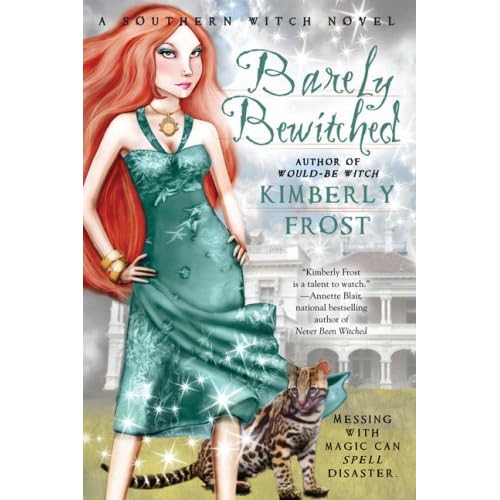
WOULD-BE WITCH by Kimberly Frost
WOULD-BE WITCH needs a minor "friend full disclosure." While I don't know Kimberly all that well, we travel in the same circles. Just FYI.
A reviewer compared Frost's first novel to Janet Evanovich's Stephanie Plum series, and I totally see it. Tammy Jo Trask, Frost's "would-be witch," is sassy and funny and quick to whip out the feminine wiles to get what she needs or wants.
The Trask family isn't the only family of powerful witches in the tiny town of Duval, TX-- in fact, Duval may be to witches what Cabot Cove was to murderers. There's also the Lyons family, including hunky Bryn Lyons who may be a bad ass good guy or may be the bad guy. And werwolves. And a ghost of a witch who lives in a locket. And gay vampires. And...
The story revolves around the theft of the previously mentioned locket. As luck would have it for Tammy Jo, who didn't inherit her family's serious witch mojo-- we think--, the powerful members of her family are out of town and not due back for a while. Not only that, but she's just been fired and she's dead broke and her ex-husband is all up in her grill. So it's a bad time, but it's up to her to get the locket-- and her family ghost, Edie-- back. With the help of a truly awesome kitty cat (my favorite character in the book) and the suspicious aid of Bryn Lyons, Tammy Jo gets tangled up in a dangerous subculture (for lack of a better word) as the hidden magical world of Duval spins out of control and begins to threaten the safety (and ignorance) of the town's non-magical citizens.
Frost has an excellent sense of humor-- great comedic timing. That's the best part of this book. I'm not the ideal audience for chick lit/romance. Most of the reviewers of Frost's book, both on Amazon and on her own site, say that the love triangle between Tammy Jo, Bryn, and Tammy Jo's ex-husband Kyle is "hot." I found her damsel-in-distress-ness kind of unappealing after a while, and both men in her life made me a bit squeamish. (Especially Kyle, who is wicked pushy and alpha-male-y and doesn't even believe in the ghost in the locket or all this witch stuff-- why would she marry this guy in the first place, and why the heck is she still schtupping him??)
But this book bummed me out in the way that Christopher Moore's books sometimes bum me out. I love Christopher Moore, and I love the humor in WOULD-BE WITCH. CM's books are must-reads, but their female characters are total stereotypes more often than not. Frost's writing rocks; I just wish Tammy Jo was a character I could sink my teeth into (bad vampire pun).
WOULD-BE WITCH is the first book in a series, and my hope is that as Tammy Jo develops as a character, she'll whip out her inner ocelot and start saving herself a bit more often. (And she can start by saving herself from her jerkoff ex-husband!!)
A reviewer compared Frost's first novel to Janet Evanovich's Stephanie Plum series, and I totally see it. Tammy Jo Trask, Frost's "would-be witch," is sassy and funny and quick to whip out the feminine wiles to get what she needs or wants.
The Trask family isn't the only family of powerful witches in the tiny town of Duval, TX-- in fact, Duval may be to witches what Cabot Cove was to murderers. There's also the Lyons family, including hunky Bryn Lyons who may be a bad ass good guy or may be the bad guy. And werwolves. And a ghost of a witch who lives in a locket. And gay vampires. And...
The story revolves around the theft of the previously mentioned locket. As luck would have it for Tammy Jo, who didn't inherit her family's serious witch mojo-- we think--, the powerful members of her family are out of town and not due back for a while. Not only that, but she's just been fired and she's dead broke and her ex-husband is all up in her grill. So it's a bad time, but it's up to her to get the locket-- and her family ghost, Edie-- back. With the help of a truly awesome kitty cat (my favorite character in the book) and the suspicious aid of Bryn Lyons, Tammy Jo gets tangled up in a dangerous subculture (for lack of a better word) as the hidden magical world of Duval spins out of control and begins to threaten the safety (and ignorance) of the town's non-magical citizens.
Frost has an excellent sense of humor-- great comedic timing. That's the best part of this book. I'm not the ideal audience for chick lit/romance. Most of the reviewers of Frost's book, both on Amazon and on her own site, say that the love triangle between Tammy Jo, Bryn, and Tammy Jo's ex-husband Kyle is "hot." I found her damsel-in-distress-ness kind of unappealing after a while, and both men in her life made me a bit squeamish. (Especially Kyle, who is wicked pushy and alpha-male-y and doesn't even believe in the ghost in the locket or all this witch stuff-- why would she marry this guy in the first place, and why the heck is she still schtupping him??)
But this book bummed me out in the way that Christopher Moore's books sometimes bum me out. I love Christopher Moore, and I love the humor in WOULD-BE WITCH. CM's books are must-reads, but their female characters are total stereotypes more often than not. Frost's writing rocks; I just wish Tammy Jo was a character I could sink my teeth into (bad vampire pun).
WOULD-BE WITCH is the first book in a series, and my hope is that as Tammy Jo develops as a character, she'll whip out her inner ocelot and start saving herself a bit more often. (And she can start by saving herself from her jerkoff ex-husband!!)
Friday, February 6, 2009
THE UNNATURAL HISTORY OF CYPRESS PARISH by Elise Blackwell
For obvious reasons, I am both drawn to and repelled by novels about hurricanes, especially those about Katrina. I could barely get through chapter one of James Lee Burke's TIN ROOF BLOWDOWN. I first cracked the spine while sneaking a cigarette break during lunch while teaching on the campus of Skidmore College a couple of summers ago. And my response to the first few pages was bodily, visceral, and dramatic. Self-preservation made me close the book before I got through more than two or three pages; I knew if I kept reading, I wouldn't be able to go back to my class full of fourteen and fifteen year olds and roll onward with Hamlet.
And my response late last year to CATEGORY FIVE by TJ McGregor was: "This book was published in 2005, before Hurricane Katrina, and it is so prescient that at times it made this Katrina survivor's knees get weak."
But with UNNATURAL HISTORY, here we have a book explicitly dealing with Katrina, and... nothing. Really.
My first reaction to this book was to think that the Katrina sections felt forced. They are the "present day" of the book during which the protagonist, Louis, waits for Katrina to hit and reflects upon the 1927 Mississippi River flood/levee blasting, the locus of the main plot of the novel. The Katrina sections bookend the 1927 plotline; like in the recent movie, Benjamin Buttons, these moments felt like an afterthought-- dry and emotionless (clearly F.Scott Fitzgerald did not address a coming hurricane in his short story from which Buttons takes its inspiration). Anyone who lived in any proximity to the Katrina landfall knows that those moments before the storm struck were anything but emotionless.
My instincts may have been right about these sections. According to a review from the Washington Post: "When Katrina struck Louisiana in 2005, Elise Blackwell was deep into a novel about the flood that struck Louisiana in 1927. 'This still spooks me,' she says, and that uncanny repetition of disaster forced her to revise what she'd written."
(nb. I am not criticizing the idea of revising a work in process to reflect a current event; I tried to include Katrina in the work that I had in progress-- it's a slog, and I don't know if it will work. But you have to be honest to the event, give it some time to shift around and find its proper level. Note that the uberprolific Dean Koontz has taken more than four years to produce the third in his series of modern Frankenstein novels, set in New Orleans. His delay was said to be because he didn't want to unleash any more destruction on New Orleans-- even fictional destruction. But it also took him time to figure out how to handle Katrina. My sense is that Blackwell didn't take enough of that time.)
In 1927, Louis lives in the fictional Cypress Parish, the son of the lumber town's Superintendent-- the most important man in town. As he grows up and watches town politics and the relationships between his father and officials on both a local and a statewide level, Louis begins to understand that his dad is just a small fish. There are other ponds too, as there always have been in renegade rural Louisiana, organized (and disorganized) crime and labor. It's not until Louis gets a job working as a driver for one of those shady characters that he begins to see all these layers of government (I use that term loosely) and how they work.
There's a love story. A lovely story about a local painter. Some Southern Gothic over-the-top tall-tales. But none of those really resonanted with me. My favorite parts of the book were those that described the local flora and fauna and other threats (leprosy!) and were meant to mimic the tone of a Natural History book. Louis, you see, is fond of Pliny.
All-in-all, this book felt flat, emotionless, stagnant. It all felt like Pliny. Not a book about a coming flood, but a book where the waters felt still, indeed.
And my response late last year to CATEGORY FIVE by TJ McGregor was: "This book was published in 2005, before Hurricane Katrina, and it is so prescient that at times it made this Katrina survivor's knees get weak."
But with UNNATURAL HISTORY, here we have a book explicitly dealing with Katrina, and... nothing. Really.
My first reaction to this book was to think that the Katrina sections felt forced. They are the "present day" of the book during which the protagonist, Louis, waits for Katrina to hit and reflects upon the 1927 Mississippi River flood/levee blasting, the locus of the main plot of the novel. The Katrina sections bookend the 1927 plotline; like in the recent movie, Benjamin Buttons, these moments felt like an afterthought-- dry and emotionless (clearly F.Scott Fitzgerald did not address a coming hurricane in his short story from which Buttons takes its inspiration). Anyone who lived in any proximity to the Katrina landfall knows that those moments before the storm struck were anything but emotionless.
My instincts may have been right about these sections. According to a review from the Washington Post: "When Katrina struck Louisiana in 2005, Elise Blackwell was deep into a novel about the flood that struck Louisiana in 1927. 'This still spooks me,' she says, and that uncanny repetition of disaster forced her to revise what she'd written."
(nb. I am not criticizing the idea of revising a work in process to reflect a current event; I tried to include Katrina in the work that I had in progress-- it's a slog, and I don't know if it will work. But you have to be honest to the event, give it some time to shift around and find its proper level. Note that the uberprolific Dean Koontz has taken more than four years to produce the third in his series of modern Frankenstein novels, set in New Orleans. His delay was said to be because he didn't want to unleash any more destruction on New Orleans-- even fictional destruction. But it also took him time to figure out how to handle Katrina. My sense is that Blackwell didn't take enough of that time.)
In 1927, Louis lives in the fictional Cypress Parish, the son of the lumber town's Superintendent-- the most important man in town. As he grows up and watches town politics and the relationships between his father and officials on both a local and a statewide level, Louis begins to understand that his dad is just a small fish. There are other ponds too, as there always have been in renegade rural Louisiana, organized (and disorganized) crime and labor. It's not until Louis gets a job working as a driver for one of those shady characters that he begins to see all these layers of government (I use that term loosely) and how they work.
There's a love story. A lovely story about a local painter. Some Southern Gothic over-the-top tall-tales. But none of those really resonanted with me. My favorite parts of the book were those that described the local flora and fauna and other threats (leprosy!) and were meant to mimic the tone of a Natural History book. Louis, you see, is fond of Pliny.
All-in-all, this book felt flat, emotionless, stagnant. It all felt like Pliny. Not a book about a coming flood, but a book where the waters felt still, indeed.
Friday, January 23, 2009
MOTEL OF THE STARS by Karen McElmurray
Jason Sanderson is a very sad man. He has a sad job (repo man). His family life is sad-- first wife and only child are both dead. His current home life is sad-- he's married to a woman who neither understands him (keeps dragging him to new age-y couples groups) nor his loss (stages a horribly gauche and insensitive sort of grief intervention on the 10th anniversary of the death of the son-- perhaps the most brilliantly written and upsetting scene in the book).
Lory Llewellyn is a very sad woman. She has a sad job (accountant for her skeezy step dad's eponymous hotel). Her family life is sad-- mom ran away and stepdad is, as I said, skeezy, and an alcoholic. Her current home life is sad-- almost ten years ago her lover died in a helicopter crash and she's never recovered. She's a cutter. She's reclusive.
The parallel stories of these two depressed and depressing folk who share their love and loss of Sam Sanderson, Jason's son and Lory's lover, run in elegant and poetic prose until they converge (perhaps inevitably, but somehow the convenience is tempered by how poetic the whole book is). Infused with and often critical of both quack spirituality and the "real" deal, MOTEL OF THE MYSTERIES is an exploration of grief, of family, of dependancy.
This is a sad book. It will make you hurt. But the writing is so extraordinarily good that you'll enjoy that pain.
This is McElmurray's second novel. The first, STRANGE BIRDS IN THE TREE OF HEAVEN, was also a gorgeously crafted book, but it was a little harder to follow, a little more abstract. MOTEL has been very well received. One blogger named it her novel of the year.
McElmurray was born and raised in Kentucky. Her book is published by the local Sarabande Books as part of the Linda Bruckheimer (who I keep confusing with Linda Wurthhiemer) Series in KY Literature (click here) -- which I'd never heard of until I came across this book.
And she's reading tonight (with Sean Hill and Elizabeth Bradfield) at 7:30pm at the Frankfort Avenue Carmichael's. Check it out and pick up the book.
Lory Llewellyn is a very sad woman. She has a sad job (accountant for her skeezy step dad's eponymous hotel). Her family life is sad-- mom ran away and stepdad is, as I said, skeezy, and an alcoholic. Her current home life is sad-- almost ten years ago her lover died in a helicopter crash and she's never recovered. She's a cutter. She's reclusive.
The parallel stories of these two depressed and depressing folk who share their love and loss of Sam Sanderson, Jason's son and Lory's lover, run in elegant and poetic prose until they converge (perhaps inevitably, but somehow the convenience is tempered by how poetic the whole book is). Infused with and often critical of both quack spirituality and the "real" deal, MOTEL OF THE MYSTERIES is an exploration of grief, of family, of dependancy.
This is a sad book. It will make you hurt. But the writing is so extraordinarily good that you'll enjoy that pain.
This is McElmurray's second novel. The first, STRANGE BIRDS IN THE TREE OF HEAVEN, was also a gorgeously crafted book, but it was a little harder to follow, a little more abstract. MOTEL has been very well received. One blogger named it her novel of the year.
McElmurray was born and raised in Kentucky. Her book is published by the local Sarabande Books as part of the Linda Bruckheimer (who I keep confusing with Linda Wurthhiemer) Series in KY Literature (click here) -- which I'd never heard of until I came across this book.
And she's reading tonight (with Sean Hill and Elizabeth Bradfield) at 7:30pm at the Frankfort Avenue Carmichael's. Check it out and pick up the book.
Wednesday, November 26, 2008
TWILIGHT by Stephanie Meyer
Really? That's what all this fuss is about?? Sparkly bear-sucking vampires? Seriously? I'm stunned. I mean, it wasn't a BAD read. But Harry Potter it ain't, folks. I'd put that in all caps if it weren't super-abnoxious to do so. But it bears (no pun intended) repeating: Harry Potter it ain't.
I've read JK Rowling, and you, Stephanie Meyer, are no JK Rowling.
I'm kind of bummed, to be honest. Some of my favorite students are loyal Twilighters. But, freak though she is, I'll take Anne Rice and her Lestat (et al) over Meyer and her Cullens any day.
What impresses me most, though, is that these voracious teens kept reading. Some of TWILIGHT is seriously, swamp-slogging slow.
I zoomed through the book in an effort to finish it before the movie came out, and I would have made it had there not been these scenes that totally stalled out. (Another scene in bio class? Another scene in the lunch room? Oh Lordy, who ever thought teen drama could be so undramatic!?) But with the current reviews of the movie, I don't think I'll bother. First of all, the book didn't grab me. Secondly, have you seen the lead actor's eyebrows? Not what I'd call hot stuff-- I give him twenty more years before he starts to look like Robin Williams. And apparently the actress who plays Bella is even more sullen than the actual character of Bella, who is already intolerably sullen.
Will I read the other two books? Probably, in due time. I have a hard time putting down books in a series. And I have to give credit to any book that gets kids (or keeps kids) reading. But I understood Harry Potter. I adored Harry Potter. I will defend Harry Potter and the quality of Rowling's work to the end. The HP series was about so much more than just a teen wizard. I admire the Meyer story and I admire the effect she's had on teens. But I don't admire her work, thus far. TWILIGHT, however, doesn't seem much more than just a Harlequin Romance for teens.
I've read JK Rowling, and you, Stephanie Meyer, are no JK Rowling.
I'm kind of bummed, to be honest. Some of my favorite students are loyal Twilighters. But, freak though she is, I'll take Anne Rice and her Lestat (et al) over Meyer and her Cullens any day.
What impresses me most, though, is that these voracious teens kept reading. Some of TWILIGHT is seriously, swamp-slogging slow.
I zoomed through the book in an effort to finish it before the movie came out, and I would have made it had there not been these scenes that totally stalled out. (Another scene in bio class? Another scene in the lunch room? Oh Lordy, who ever thought teen drama could be so undramatic!?) But with the current reviews of the movie, I don't think I'll bother. First of all, the book didn't grab me. Secondly, have you seen the lead actor's eyebrows? Not what I'd call hot stuff-- I give him twenty more years before he starts to look like Robin Williams. And apparently the actress who plays Bella is even more sullen than the actual character of Bella, who is already intolerably sullen.
Will I read the other two books? Probably, in due time. I have a hard time putting down books in a series. And I have to give credit to any book that gets kids (or keeps kids) reading. But I understood Harry Potter. I adored Harry Potter. I will defend Harry Potter and the quality of Rowling's work to the end. The HP series was about so much more than just a teen wizard. I admire the Meyer story and I admire the effect she's had on teens. But I don't admire her work, thus far. TWILIGHT, however, doesn't seem much more than just a Harlequin Romance for teens.
Saturday, November 15, 2008
CATEGORY FIVE by TJ MacGregor
I can't tell you how frustrating it has been to take SO long to read a book. This speaks only to my current health/stress and not at all to the quality of Category Five.
This book was published in 2005, before Hurricane Katrina, and it is so prescient that at times it made this Katrina survivor's knees get weak. I am also a closet conspiracy theorist, or at least a woman who is more than willing to give her ear to conspiracy theorists, and this book fed my concerns about FEMA, about our country's natural disaster response, and about our level of preparedness for disasters both man-made and natural.
I picked up this book for a number of reasons. I met MacGregor in 2002 and thought she was the bees' knees. I found it at a used book store for a couple of bucks. And when I read the back cover, I realized that it addressed a Cat5 hurricane in a marginally pre-Katrina world.
I didn't realize when I bought it that it was the 4th book in a series featuring Mira Morales, a psychic on Tango Key in Florida. But, though I normally hate picking up book so late in a series, MacGregor did enough to fill me in that I felt very comfortable with all of the characers and all of the situations. In fact, MacGregor has a book called Black Water that I feel like I could skip seeing that the central conflictof that book comes up repeatedly in this one.
All of the characters in this book are so well-drawn, from the series staples of Mira and Shepard and Annie and Nadine, to the newcomers of Tia and Crystal and Franklin. I feel safe hearing the story through the minds of any of these characters and MacGregor does an excellent job balancing the narration between these folks.
More than anything else, this book made me want to spend some time really looking into what happened during Hurricane Andrew in S. Florida. And I appreciate this call to arms. Katrina, I think, has been analyzed to death, but was Andrew so scrutinized?
This book was published in 2005, before Hurricane Katrina, and it is so prescient that at times it made this Katrina survivor's knees get weak. I am also a closet conspiracy theorist, or at least a woman who is more than willing to give her ear to conspiracy theorists, and this book fed my concerns about FEMA, about our country's natural disaster response, and about our level of preparedness for disasters both man-made and natural.
I picked up this book for a number of reasons. I met MacGregor in 2002 and thought she was the bees' knees. I found it at a used book store for a couple of bucks. And when I read the back cover, I realized that it addressed a Cat5 hurricane in a marginally pre-Katrina world.
I didn't realize when I bought it that it was the 4th book in a series featuring Mira Morales, a psychic on Tango Key in Florida. But, though I normally hate picking up book so late in a series, MacGregor did enough to fill me in that I felt very comfortable with all of the characers and all of the situations. In fact, MacGregor has a book called Black Water that I feel like I could skip seeing that the central conflictof that book comes up repeatedly in this one.
All of the characters in this book are so well-drawn, from the series staples of Mira and Shepard and Annie and Nadine, to the newcomers of Tia and Crystal and Franklin. I feel safe hearing the story through the minds of any of these characters and MacGregor does an excellent job balancing the narration between these folks.
More than anything else, this book made me want to spend some time really looking into what happened during Hurricane Andrew in S. Florida. And I appreciate this call to arms. Katrina, I think, has been analyzed to death, but was Andrew so scrutinized?
Monday, October 13, 2008
Sunday, September 21, 2008
Sunday, September 7, 2008
THE MOOR by Laurie R. King
Mary Russell and Sherlock Holmes return to the site of his most famous case-- the moors surrounding Baskerville Hall-- for another crack at a ghostly hound and case buoyed by the folklore and superstitions of the people of the moors.
Friday, September 5, 2008
Friday, August 29, 2008
Tuesday, August 26, 2008
NATURE GIRL by Carl Hiaasen
I'm a huge Carl Hiassen fan; I've read almost every novel he's ever written. But this book was a slog. I found myself skipping paragraphs, skimming pages. It just seemed tired and old Hiaasen stuff. There was no character to latch onto-- all of them seemed stretched like Silly Putty beyond belief. I couldn't wait to be done with it so I could take up the next Laurie R. King book. But, as usual, I am loathe to abandon books.
Wednesday, August 20, 2008
THE BEEKEEPER'S APPRENTICE by Laurie R. King
There are few things better than liking a book and a character so much that it borders on obsession. Ever since my cousin loaned me THE BEEKEEPER'S APPRENTICE, I've had dreams about Mary Russell and her world. And now that I've spent a little bit of time on Laurie R. King's website and read a little of her blog, I'm discovering that the author is as totally charming as her creation.The Mary Russell novels are set in Post WWI England. A troubled teenaged orphan literally trips over a man while strolling in the countryside, her nose buried in a book. The man, it turns out, is the very real and semi-retired Sherlock Holmes, who, well into middle age, has become a pop culture myth in his own time created by (and in his opinion much maligned by) the too liberal pen of Arthur Conan Doyle. This chance meeting becomes the apprenticeship in the title, and eventually a partnership and eventually more.
I have always had a deep love for Holmes, whether in the books or on television. My love for Nancy Drew immediately led me to Holmes who led me to Agatha Christie and a subsequent passion for the classic detective novel in general-- the dusty, library detectives specifically. And King's Holmes is a masterpiece in his faded and sometimes ridiculous brilliance. He's a genius but emotionally stunted. He's callous and cold but also wounded and vulnerable. But he's got this sexy, Indiana Jones at 60-ish thing going on too.
But of course, it is Russell who becomes the iconic figure through King's series (I'm on Book 3). She ranks right up there with the Great Women of Fiction, in my opinion. I used to want to be Jane Eyre when I grew up, now I want to be Mary Russell (yes, I recognize that I am more than a decade older than either of these women at their literary height).
Russell is exceptionally smart and is an equal to Holmes almost immediately. But where he is coarse, she is gentle and emotionally intelligent. She, too, is wounded, but she is not scarred over (well, yes she is, physically). She's the tomboy, preferring her father's clothes to her own (for sentimental reasons as well) and the independent woman of the age of sufferage, even as a girl. She is a wit. And let's face it, the cover image on every book of the series paints her as sexy as hell.
King's writing is exceptionally rich and engaging, and perhaps most impressive is her brilliant command of the time period-- not just the history, but the social sentiment, the attitudes, the mores-- you feel as though you are in the hands of not just a fantastic writer, but a scholar. In addition, King brings her background in theology to bear through Russell's studies at Oxford.
Yes, I gush. But really, this is what you dream of (or at least I do) when you think about summer reading-- something that reads like a dream and leaves you smarter... and dreaming.
Wednesday, August 6, 2008
CANCER VIXEN by Marisa Acocella Marchetto
Graphic novel. Sex in the City meets breast cancer minus Samantha's pink hair.
GREAT WHITE by Peter Benchley
Not really about a shark...
But about my hometown in Connecticut under a different name.
DEEP SIX by Randy Striker (Randy Wayne White)
Re-published early thriller/mystery from South Florida's Randy Wayne White writing under the pseudonym Striker.
Labels:
mystery,
south florida,
thriller,
white
Subscribe to:
Posts (Atom)